

Documentation Index
Fetch the complete documentation index at: https://docs.codatta.io/llms.txt
Use this file to discover all available pages before exploring further.
Overview
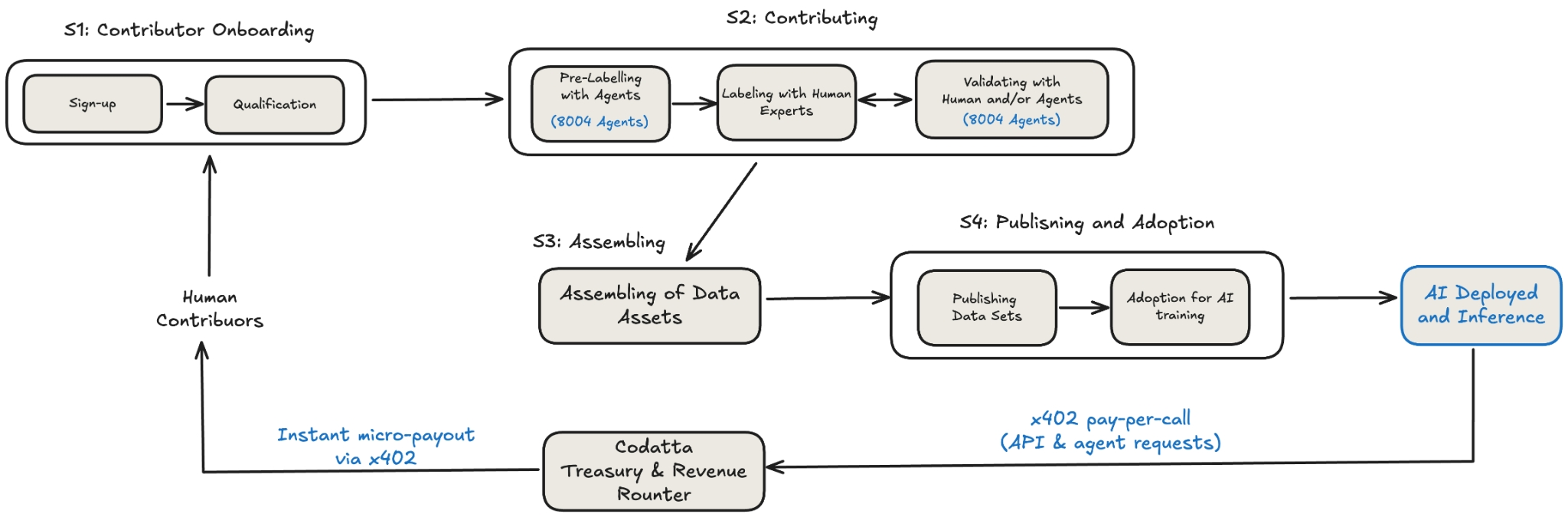
To plug cleanly into the emerging agent economy, we standardize on:
- ERC-8004 for agent identity and trust on Ethereum
- x402 for HTTP-native, pay-per-request payments
1. Background
ERC-8004 (Trustless Agents) is an Ethereum standard that adds a trust layer on top of agent protocols.It defines three on-chain registries—Identity, Reputation, and Validation—so agents can be discovered and judged by a shared record of their behavior (Ethereum Improvement Proposals). x402 is an open, chain-agnostic payment protocol that reuses the HTTP
402 Payment Required status code so clients (humans or AI agents) can pay for APIs and content directly over HTTP with crypto, typically stablecoins (Coinbase Developer Docs).
2. How we adopt ERC-8004
In Codatta, agents help with pre-labelling, triage, and validation alongside human experts. We use ERC-8004 to make these agents first-class, verifiable participants:-
Agent registration
Each Codatta agent (for example “transaction classifier”, “KYB triage”, “policy validator”) is listed in the ERC-8004 Identity Registry with:- its MCP/A2A endpoint
- capability description
- basic pricing metadata
-
On-chain reputation and validation
As agents pre-label and validate tasks, we emit:- Reputation entries summarizing outcomes (accept rate, conflicts with humans, slashing events)
- Validation entries pointing to off-chain logs or evaluation reports via URIs (Composable Security)
-
Link to data ownership
For each job, our internal systems record which data portfolios and contributors were involved.
ERC-8004 events include references to those IDs in their evidence fields; our indexers then map agent activity to:- which data assets were used
- which humans and agent operators should share future revenue (Medium)
3. How we adopt x402
We use x402 as the payment rail for Codatta APIs and agent endpoints.Pay-per-use access
Any paid Codatta endpoint (for example, “label this batch”, “score this transaction”, “fetch this dataset slice”) follows the x402 flow:- Client calls the endpoint.
- If payment is required, we return
402 Payment Requiredplus an x402 payment description (amount, currency, destination, expiry) (Coinbase Developer Docs). - The client (human app or AI agent) pays and retries the request with the x402 authorization header.
From revenue to rewards
Once a payment settles to Codatta:- We attribute the call to:
- the data portfolios used, and
- the agents and humans who contributed to them.
- Revenue is split according to our staking and ownership rules and streamed out as micro-payouts to contributors and agent operators, with the remainder going to the protocol treasury (Coinbase Developer Docs).
4. Putting it together
- ERC-8004 turns Codatta agents into discoverable, auditable actors with shared identity and trust signals.
- x402 turns each API or agent call into a programmable payment event, which we route back through Codatta’s ownership graph.